








- Konu Yazar
- #1
The Lean Palletization Experience combines modular robots and attachments, offering scalable, customizable palletizing solutions.
Robotiq has introduced the Lean Palletization Experience, a comprehensive solution designed to make pallet automation more accessible and cost-effective. Combining digital simulation tools with flexible hardware options, the program allows companies to validate palletizing layouts before deployment, reducing errors and delays. With ready-to-deploy cells and modular system configurations, Robotiq helps warehouses and factories cut labor costs, minimize product damage, and improve ergonomics—all while ensuring scalability and quick return on investment in pallet handling operations.
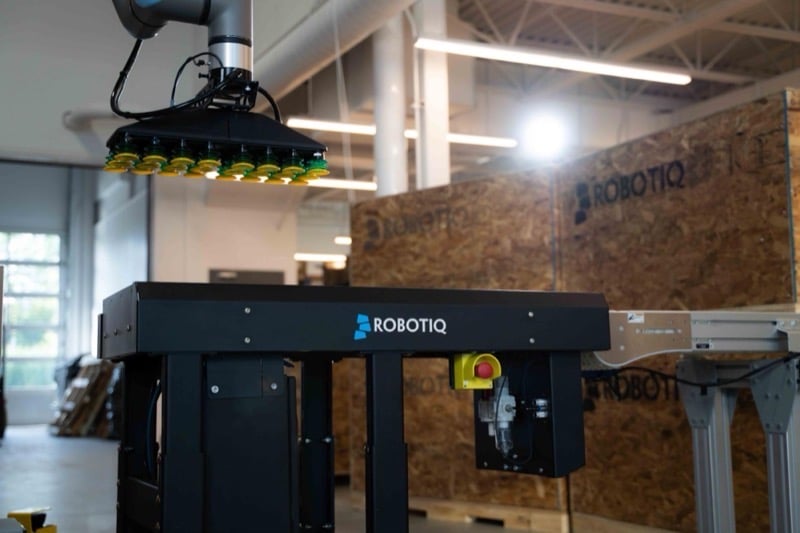
Robotiq PAL Ready cell arrives preassembled, tested, and deployment-ready for palletizing tasks.
Robotiq PAL Ready cell arrives preassembled, tested, and deployment-ready for palletizing tasks. Image courtesy of Robotiq
Robotiq PAL Ready cell arrives preassembled, tested, and deployment-ready for palletizing tasks. Image courtesy of Robotiq
Automated palletization offers savings in operating costs, labor, and time. Operating costs are reduced, as properly configured robots will damage fewer items than manual labor. Shrink, product returns from refusing to accept a damaged package, warranty returns from product damage, and other such problems will be drastically reduced.
On the labor side, replacing manual palletization with automation reduces the risk of repetitive strain injuries. These ergonomic injuries are painful and costly, and are nearly unavoidable in the warehouse setting. Even with proper lift training, it is still a major risk and expense. Automation reduces this risk entirely.
The Lean Palletization Experience starts in software, using the Online Configurator to design layouts of the palletization area. From there, the Palletization Fit Tool can validate the design and the robotic motion required to perform the palletization operations.
Outside of software, the Lean Palletization
Experience has two separate pathways to completion: Robot PAL Ready and Robot PAL Series.
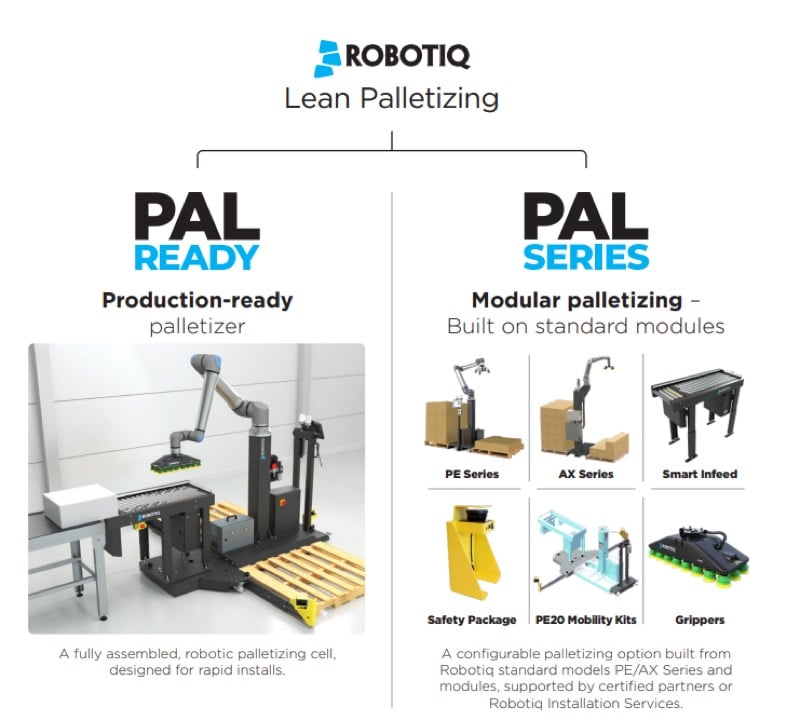
The Lean Palletization Experience combines modular robots and attachments, offering scalable, customizable palletizing solutions.
The Lean Palletization Experience combines modular robots and attachments, offering scalable, customizable palletizing solutions. Image used courtesy of Robotiq
The Lean Palletization Experience combines modular robots and attachments, offering scalable, customizable palletizing solutions. Image used courtesy of Robotiq
Robot PAL Ready
The Robot PAL Ready is a palletization robot cell ready to go. It has been assembled, tested, and is ready for deployment when it arrives on the factory floor. At its core is a Robotiq PowerPick Multi Vacuum Gripper for handling boxes. This cell can stack pallets to 87” high, handling up to 46 lb packages at speeds of 13 boxes per minute.
It also has a Robotiq Smart Infeed for box handling and communication. This system includes safety scanners to ensure a moving robot does not contact workers and mobility features that allow robots to change production lines quickly.
Robot PAL Series
The Robot PAL Series is not a single robot, but a highly configurable system made from standard Robotiq models, such as the PE/AX series. The end user can configure this series to meet their production needs, such as changing grippers, infeed conveyors, safety mechanisms, etc. The components are shipped to the site and can be installed by Robotiq Installation Services or through certified partners.
Simulating and validating the palletization operation before physically constructing the automation system offers tremendous time and labor savings. This is made possible through the Online Configurator and Palletization Fit Tool.
Many palletization systems must be redesigned entirely during business expansion. The Lean Palletization Experience
is scalable and can grow as throughput increases. This is a tremendous saving in both time and cost.
Palletization is often treated as an unfixable step–one that is required but has no room for optimization. Alternatively, automating the palletization step seems cost-prohibitive and is avoided. With the Lean Palletization Experience, automating the palletization process can be cost-effective and painless. It reduces operating expenses in labor, shrink due to damaged goods, and can increase the throughput of products to the customer.
Robotiq has introduced the Lean Palletization Experience, a comprehensive solution designed to make pallet automation more accessible and cost-effective. Combining digital simulation tools with flexible hardware options, the program allows companies to validate palletizing layouts before deployment, reducing errors and delays. With ready-to-deploy cells and modular system configurations, Robotiq helps warehouses and factories cut labor costs, minimize product damage, and improve ergonomics—all while ensuring scalability and quick return on investment in pallet handling operations.
Robotiq PAL Ready cell arrives preassembled, tested, and deployment-ready for palletizing tasks.
Robotiq PAL Ready cell arrives preassembled, tested, and deployment-ready for palletizing tasks. Image courtesy of Robotiq
Robotiq PAL Ready cell arrives preassembled, tested, and deployment-ready for palletizing tasks. Image courtesy of Robotiq
Automated palletization offers savings in operating costs, labor, and time. Operating costs are reduced, as properly configured robots will damage fewer items than manual labor. Shrink, product returns from refusing to accept a damaged package, warranty returns from product damage, and other such problems will be drastically reduced.
On the labor side, replacing manual palletization with automation reduces the risk of repetitive strain injuries. These ergonomic injuries are painful and costly, and are nearly unavoidable in the warehouse setting. Even with proper lift training, it is still a major risk and expense. Automation reduces this risk entirely.
The Lean Palletization Experience starts in software, using the Online Configurator to design layouts of the palletization area. From there, the Palletization Fit Tool can validate the design and the robotic motion required to perform the palletization operations.
Outside of software, the Lean Palletization
Experience has two separate pathways to completion: Robot PAL Ready and Robot PAL Series.
The Lean Palletization Experience combines modular robots and attachments, offering scalable, customizable palletizing solutions.
The Lean Palletization Experience combines modular robots and attachments, offering scalable, customizable palletizing solutions. Image used courtesy of Robotiq
The Lean Palletization Experience combines modular robots and attachments, offering scalable, customizable palletizing solutions. Image used courtesy of Robotiq
Robot PAL Ready
The Robot PAL Ready is a palletization robot cell ready to go. It has been assembled, tested, and is ready for deployment when it arrives on the factory floor. At its core is a Robotiq PowerPick Multi Vacuum Gripper for handling boxes. This cell can stack pallets to 87” high, handling up to 46 lb packages at speeds of 13 boxes per minute.
It also has a Robotiq Smart Infeed for box handling and communication. This system includes safety scanners to ensure a moving robot does not contact workers and mobility features that allow robots to change production lines quickly.
Robot PAL Series
The Robot PAL Series is not a single robot, but a highly configurable system made from standard Robotiq models, such as the PE/AX series. The end user can configure this series to meet their production needs, such as changing grippers, infeed conveyors, safety mechanisms, etc. The components are shipped to the site and can be installed by Robotiq Installation Services or through certified partners.
Simulating and validating the palletization operation before physically constructing the automation system offers tremendous time and labor savings. This is made possible through the Online Configurator and Palletization Fit Tool.
Many palletization systems must be redesigned entirely during business expansion. The Lean Palletization Experience
is scalable and can grow as throughput increases. This is a tremendous saving in both time and cost.
Palletization is often treated as an unfixable step–one that is required but has no room for optimization. Alternatively, automating the palletization step seems cost-prohibitive and is avoided. With the Lean Palletization Experience, automating the palletization process can be cost-effective and painless. It reduces operating expenses in labor, shrink due to damaged goods, and can increase the throughput of products to the customer.






















