








- Konu Yazar
- #1
New robotics education centers like UMaine’s B.O.T. Loft equip students with practical automation skills for advanced manufacturing.
As robotics and automation transform global industries, the U.S. faces mounting pressure to close its skilled workforce gap. New educational facilities, funded by federal and higher education initiatives and built in partnership with leading robotics companies, are answering the call. From UMaine’s B.O.T. Loft to Plymouth State’s Robotics Open Laboratory and Lamar Institute of Technology’s Advanced Technology Center, these hubs provide hands-on, industry-aligned training to prepare students for careers in smart manufacturing and beyond.
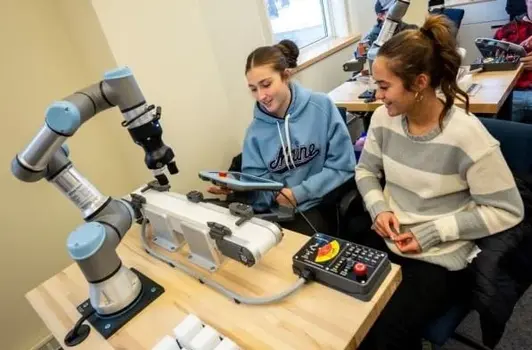
UMaine’s B.O.T. Loft provides human-robot collaborative learning, expert-led teaching, and certificated programs to boost skills and strengthen the future Smart Manufacturing workforce.
UMaine’s B.O.T. Loft provides human-robot collaborative learning, expert-led teaching, and certificated programs to boost skills and strengthen the future Smart Manufacturing workforce. Image used courtesy of UMaine
UMaine’s B.O.T. Loft provides human-robot collaborative learning, expert-led teaching, and certificated programs to boost skills and strengthen the future Smart Manufacturing workforce. Image used courtesy of UMaine
Robotics and Automation in the U.S.
According to a market report by the International Federation of Robotics, the United States ranks tenth in the world in terms of the penetration of robotics and automation in the manufacturing industry, with a robot density of 295 robots per 10,000 workers. In contrast, China has a higher robot density with 470 robots per 10,000 workers, which is undoubtedly aided by its national robotics strategy. China’s manufacturing industry installed an impressive 280,000 units each year between 2021 and 2023, with the U.S. achieving a meagre 34,300 installations in 2024. Of these installations, 40% were in the automotive sector. Though China is a substantial and dynamic producer of robotics, Japan takes the lead, w
ith China followed by Germany and South Korea. Robotics manufacturers in the U.S. are fewer in number, and the U.S. lacks a comprehensive national robotics strategy.
The U.S. mainly relies on imports, which come with increased tariffs, deterring U.S. manufacturers from automating. Installation costs from facility setup, including sensors, conveyors, charging and docking stations, and other key infrastructure, can also prevent robotization and automation in manufacturing. The lack of skilled labor to facilitate the installation and maintenance of robotics and automated technologies is also a barrier to wider adoption.
Federal government funding of $7 million secured by U.S. Rep. Jared Golden, requested by the University of Maine System (UMS), and with the support of the Maine Congressional Delegation, made the B.O.T. Loft a reality.
UMaine’s B.O.T. Loft Facility
The University of Maine has announced the opening of its Build, Optimize, and Train (B.O.T.) Loft educational facility, geared toward preparing the state and nation’s future industrial workforce for robotized and automated Smart Manufacturing operations. The B.O.T. Loft covers 3,600 square feet above UMaine’s Advanced Manufacturing Center. The educational hub offers factory-authorized training, industry-recognized and certificated microcredentials for quick upskilling, and summer camps dedicated to educating from grades K to 12. The facility incorporates robotics and automation technologies from leading manufacturers, including Universal Robots, ABB Robotics, Doosan Robotics, and Fanuc.
Students not only get to interact with and learn to operate collaborative robots, but at the end of the six-day summer camp, come away with a Universal Robots Educational Robotics Training – Core (ERT-C) credential. The Maine Defense Industry Alliance covered tuition fees for the summer camp’s July intake.
The academic robotics and automation education hub facilitates direct pathways into Maine’s manufacturing workforce
by collaborating directly with industry professionals.
Plymouth State’s Robotics Open Laboratory
Students now have the opportunity to utilise cutting-edge robotics technology and experiential learning possibilities at Plymouth State University's (PSU) new 4,000-square-foot Robotics Open Laboratory. The 4,000 square-foot lab is located in the historic Draper & Maynard Building. The building expands on PSU's establishment of New Hampshire's first bachelor's program in robotics in 2021 and was partially financed by $1 million in federal funds obtained by Senator Jeanne Shaheen. The lab will support students in gaining high-value skills for the modern workforce while fortifying ties with businesses and academic institutions.
LIT’s Advanced Technology Center
In further efforts to fill the skilled workforce gap, on April 15th this year, the Lamar Institute of Technology (LIT) opened the doors to its $6.6 million, 15,000 square-foot Advanced Technology Center. The center was constructed using a refurbished warehouse next to the Tommy Williams buildings and was financed via a mix of special legislative allocations and Higher Education Funds.
An overview of LIT’s Advanced Technology Center and its educational offerings. Video used courtesy of 12NewsNow
An overview of LIT’s Advanced Technology Center and its educational offerings. Video used courtesy of 12NewsNow
The center provides hands-on practical labs, industrial training rooms, and lecture rooms where students learn various valued industry skills. In addition to plumbing, electrics, and mechatronics, engineering technician programs covering robotics and automation, biomedical, computer, and electromechanical technologies and systems are also offered.
A Shared Vision
Growth and adoption of robotics and automation technologies cannot come without education and collaboration between academia and industry. The innovative facilities mentioned above are a product of a shared vision by academics and industry profess
ionals that involves advancing knowledge and research while upskilling the future workforce to bridge the skills gap in robotics and automation in U.S. manufacturing on a regional and, cumulatively, a national scale.
As robotics and automation transform global industries, the U.S. faces mounting pressure to close its skilled workforce gap. New educational facilities, funded by federal and higher education initiatives and built in partnership with leading robotics companies, are answering the call. From UMaine’s B.O.T. Loft to Plymouth State’s Robotics Open Laboratory and Lamar Institute of Technology’s Advanced Technology Center, these hubs provide hands-on, industry-aligned training to prepare students for careers in smart manufacturing and beyond.
UMaine’s B.O.T. Loft provides human-robot collaborative learning, expert-led teaching, and certificated programs to boost skills and strengthen the future Smart Manufacturing workforce.
UMaine’s B.O.T. Loft provides human-robot collaborative learning, expert-led teaching, and certificated programs to boost skills and strengthen the future Smart Manufacturing workforce. Image used courtesy of UMaine
UMaine’s B.O.T. Loft provides human-robot collaborative learning, expert-led teaching, and certificated programs to boost skills and strengthen the future Smart Manufacturing workforce. Image used courtesy of UMaine
Robotics and Automation in the U.S.
According to a market report by the International Federation of Robotics, the United States ranks tenth in the world in terms of the penetration of robotics and automation in the manufacturing industry, with a robot density of 295 robots per 10,000 workers. In contrast, China has a higher robot density with 470 robots per 10,000 workers, which is undoubtedly aided by its national robotics strategy. China’s manufacturing industry installed an impressive 280,000 units each year between 2021 and 2023, with the U.S. achieving a meagre 34,300 installations in 2024. Of these installations, 40% were in the automotive sector. Though China is a substantial and dynamic producer of robotics, Japan takes the lead, w
ith China followed by Germany and South Korea. Robotics manufacturers in the U.S. are fewer in number, and the U.S. lacks a comprehensive national robotics strategy.
The U.S. mainly relies on imports, which come with increased tariffs, deterring U.S. manufacturers from automating. Installation costs from facility setup, including sensors, conveyors, charging and docking stations, and other key infrastructure, can also prevent robotization and automation in manufacturing. The lack of skilled labor to facilitate the installation and maintenance of robotics and automated technologies is also a barrier to wider adoption.
Federal government funding of $7 million secured by U.S. Rep. Jared Golden, requested by the University of Maine System (UMS), and with the support of the Maine Congressional Delegation, made the B.O.T. Loft a reality.
UMaine’s B.O.T. Loft Facility
The University of Maine has announced the opening of its Build, Optimize, and Train (B.O.T.) Loft educational facility, geared toward preparing the state and nation’s future industrial workforce for robotized and automated Smart Manufacturing operations. The B.O.T. Loft covers 3,600 square feet above UMaine’s Advanced Manufacturing Center. The educational hub offers factory-authorized training, industry-recognized and certificated microcredentials for quick upskilling, and summer camps dedicated to educating from grades K to 12. The facility incorporates robotics and automation technologies from leading manufacturers, including Universal Robots, ABB Robotics, Doosan Robotics, and Fanuc.
Students not only get to interact with and learn to operate collaborative robots, but at the end of the six-day summer camp, come away with a Universal Robots Educational Robotics Training – Core (ERT-C) credential. The Maine Defense Industry Alliance covered tuition fees for the summer camp’s July intake.
The academic robotics and automation education hub facilitates direct pathways into Maine’s manufacturing workforce
by collaborating directly with industry professionals.
Plymouth State’s Robotics Open Laboratory
Students now have the opportunity to utilise cutting-edge robotics technology and experiential learning possibilities at Plymouth State University's (PSU) new 4,000-square-foot Robotics Open Laboratory. The 4,000 square-foot lab is located in the historic Draper & Maynard Building. The building expands on PSU's establishment of New Hampshire's first bachelor's program in robotics in 2021 and was partially financed by $1 million in federal funds obtained by Senator Jeanne Shaheen. The lab will support students in gaining high-value skills for the modern workforce while fortifying ties with businesses and academic institutions.
LIT’s Advanced Technology Center
In further efforts to fill the skilled workforce gap, on April 15th this year, the Lamar Institute of Technology (LIT) opened the doors to its $6.6 million, 15,000 square-foot Advanced Technology Center. The center was constructed using a refurbished warehouse next to the Tommy Williams buildings and was financed via a mix of special legislative allocations and Higher Education Funds.
An overview of LIT’s Advanced Technology Center and its educational offerings. Video used courtesy of 12NewsNow
An overview of LIT’s Advanced Technology Center and its educational offerings. Video used courtesy of 12NewsNow
The center provides hands-on practical labs, industrial training rooms, and lecture rooms where students learn various valued industry skills. In addition to plumbing, electrics, and mechatronics, engineering technician programs covering robotics and automation, biomedical, computer, and electromechanical technologies and systems are also offered.
A Shared Vision
Growth and adoption of robotics and automation technologies cannot come without education and collaboration between academia and industry. The innovative facilities mentioned above are a product of a shared vision by academics and industry profess
ionals that involves advancing knowledge and research while upskilling the future workforce to bridge the skills gap in robotics and automation in U.S. manufacturing on a regional and, cumulatively, a national scale.




















